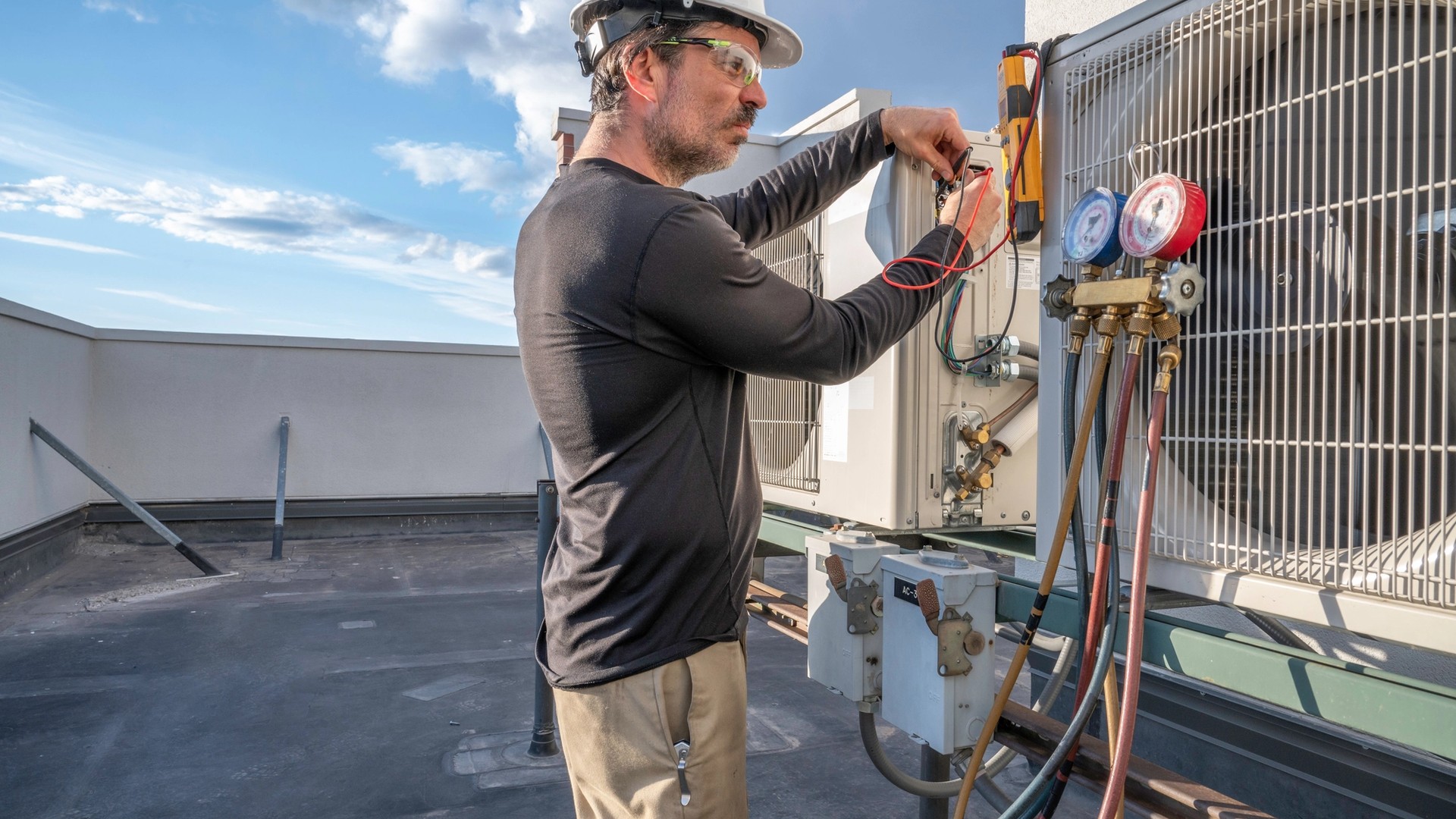
HVAC Contractor Insurance In Texas - A Guide
·
8 minute read

To purchase commercial insurance effectively in Texas, HVAC contractors must navigate three distinct layers of requirements: State Licensing (TDLR) mandates, Texas state laws, and commercial contract requirements.
The following guide outlines the critical information needed to stay compliant and protected.
What Insurance Is Required For HVAC Contractors In Texas?
The Texas Department of Licensing and Regulation (TDLR) strictly enforces insurance minimums based on your specific license class. You cannot obtain or renew your license without a Certificate of Insurance (COI) on file that meets these exact limits.
License Class Limits
| License Class | What It Permits | Required General Liability Limits |
|---|---|---|
| Class A | Any size unit (unlimited tons) | $300k Per Occurrence/ $600k Aggregate / $300k Completed Operations |
| Class B | Cooling < 25 tons; Heating < 1.5M BTUs | $100k Per Occurrence/ $200k Aggregate / $100k Completed Operations |
Texas Workers Comp (Pros & Cons of Opting Out)
Texas is like no other state in the US because it is a "non-subscriber" state, meaning private employers are not legally required by the state to carry Workers' Compensation insurance. However, this comes with major caveats for HVAC contractors:
- The "Opt-Out" Risk: If you opt out (become a "non-subscriber"), you lose the legal protection against employee lawsuits. If an employee gets hurt (e.g., heat stroke in an attic, ladder fall) and sues you, you are liable for 100% of the medical costs, plus legal defense and potential negligence damages.
- Commercial Contracts: Most General Contractors (GCs) and commercial property managers will not hire you without Workers' Comp. They do not want the liability of your injured workers transferring to them.
- Government Work: If you bid on any public works (schools, municipal buildings), Workers' Comp is usually mandatory.
Recommendation: If you have employees, Workers' Comp is highly safer than "opting out." If you are a solo owner-operator, you can often exclude yourself from coverage to lower the cost while still carrying a policy to satisfy GCs.
Essential Insurance Coverages For HVAC Contractors
Beyond the license minimums, HVAC businesses in Texas need a could of essential policies to cover the majority of their risks, being compliant for most jobs, and maintaining license requirements. Here are our recommended coverages:
General Liability Insurance
- The Risk: Property damage (e.g., water leak ruining a ceiling) or bodily injury to third parties (e.g., a customer trips over your tools).
- Why you need it: While TDLR mandates minimum limits for your license, commercial contracts often require higher limits (typically $1M per occurrence / $2M aggregate). It is the primary shield against lawsuits claiming negligence.
Workers' Compensation
- The Risk: HVAC work has high injury potential, including ladder falls, electrical shocks, and attic heat exhaustion.
- Why you need it: As detailed in Section 2, this coverage pays for injured employees' medical bills and lost wages. Crucially, it prevents employees from suing you for their injuries, protecting your business assets from devastating legal judgments.
Commercial Auto Insurance
- Why you need it: Personal auto policies almost always exclude business use. If your technician crashes a van while hauling freon and tools, a personal policy will likely deny the claim.
- Texas Minimum vs. Reality: Texas state minimums (30/60/25) are far too low for a business.
- Target Limit: Aim for $1,000,000 Combined Single Limit (CSL). This is the standard requirement to get onto commercial job sites.
Inland Marine (Tools & Equipment)
- The Risk: HVAC tools (vacuum pumps, recovery machines, gauges) are high-theft items. Standard General Liability does not cover your own property; it only covers damage you cause to others.
- The Fix: An Inland Marine floater covers your tools when they are in your van or at a job site.
LandesBlosch Recommendations
To maximize protection and minimize administrative headaches down the road, consider these strategic moves when getting a policy.
- Secure Endorsements Early: Get the blanket additional insured, waiver of subrogation, and primary non-contributory endorsements at the beginning of the policy term. Adding them later can cause delays when you are trying to get onto a job site. You can generally add an an endorsement to add all these endorsements which make you compliant for a couple hundred dollars and a certificate can be issued immediately. If not, each endorsement might cost you $50 per endorsement and it might take a week to issue the certificate. Not worth it and you will likely save money if you have more than a couple of clients.
- Evaluate Pollution Add-ons: If pollution coverage is available as an add-on (endorsement) to your general liability quote, it is probably a good deal to get it due to the exposure to refrigerant leaks.
- Plan for Growth (Umbrella): Go with a carrier that can at least offer a $3M umbrella policy. Many large commercial contracts require this limit (sometimes even $5M), and having a carrier that cannot accommodate it will force you to switch providers mid-year which takes time and is not efficient from a cost standpoint.
What Does Texas HVAC Contractor Insurance Cost?
Insurance premiums vary heavily based on revenue, payroll, and claims history. Location does matter as well since Houston is going to cost more than some smaller towns. These ranges represent typical costs for small-to-midsize Texas HVAC contractors with roughly $1M in annual revenue.
| Insurance Type | Coverage Limits | Annual Cost |
|---|---|---|
| General Liability | $1M / $2M | $600-$2,500 |
| Workers' Comp | Statutory Limits ($1M EL) | $1,500 - $3,000 |
| Commercial Auto | $1M CSL | $1,800 - $3,200 per vehicle |
| Inland Marine | $25,000 | $500 |
Best Providers For HVAC Contractor Insurance In Texas
LandesBlosch
Comprehensive market access and expert advocacy. As a specialized independent agency, LandesBlosch partners with every major carrier on this list (Chubb, Travelers, Hartford, etc.) to shop the market for you. Instead of being limited to one brand, they leverage relationships with multiple top-tier providers to build a custom insurance package that fits your specific HVAC operations and budget.
Chubb
Chubb is widely regarded as the gold standard for insurance, offering superior claims service and broad coverage forms. They are excellent for smaller HVAC operations that need high umbrella limits or specialized endorsements for complex commercial contracts.
The Hartford
The Hartford is a favorite for small business owners due to their ease of use and excellent online servicing. They offer excellent package policies (BOPs) that bundle General Liability and Property, often automatically including key endorsements like blanket additional insureds that contractors need to get on job sites quickly.
Travelers
Travelers is one of the top construction insurance carriers in the country. They are highly competitive for contractors with clean safety records. They have strong coverage forms and is a respected insurer that all your customers will accept.
Berkley Aspire
Berkley Aspire specializes in "excess and surplus" lines. If your business has had a few claims, is a new venture, or performs high-risk work (like industrial refrigeration or multi-story work) that standard carriers decline, Berkley Aspire is often the go-to solution. They offer flexibility where standard carriers offer rejections.


About The Author: Austin Landes, CIC
Austin is an experienced Commercial Risk Advisor specializing in and leading LandesBlosch's design professional, real estate, and construction teams.